India Accelerates Self-Reliance Push to Strengthen Manufacturing and Reduce Import Dependence

India is strengthening its self-reliance strategy by boosting domestic manufacturing, encouraging investments, expanding semiconductor production, and reducing dependence on imports. Learn what this means for the economy, businesses, and employment.
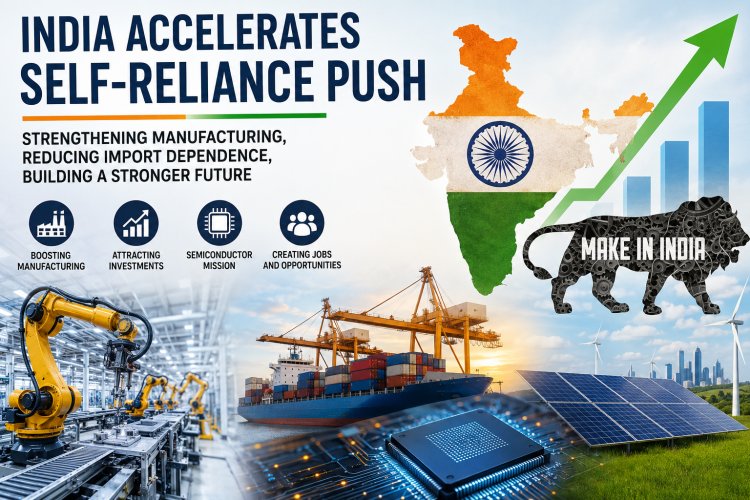
India Accelerates Self-Reliance Push to Strengthen Manufacturing and Reduce Import Dependence

India Accelerates Self-Reliance Push to Strengthen Manufacturing and Reduce

Import Dependence

India has renewed its focus on becoming more self-reliant by expanding domestic manufacturing and reducing dependence on imported goods. The initiative is part of the government's broader economic strategy to strengthen industries, create employment opportunities, improve supply chain resilience, and enhance India's position in the global manufacturing ecosystem. Recent policy discussions have highlighted efforts to replace billions of dollars' worth of imports with products manufactured within the country while continuing to attract international investment. 

This strategy is not entirely new. It builds upon initiatives such as Make in India, launched in 2014, and Atmanirbhar Bharat, introduced in 2020. These programs aim to encourage local production while making India an attractive destination for global businesses looking to diversify their manufacturing operations.

Why Self-Reliance Has Become a Priority

The global economy has experienced significant disruptions in recent years due to geopolitical tensions, changing trade patterns, supply chain bottlenecks, and economic uncertainty. These developments exposed the risks of relying heavily on imports for critical products and industrial components.

For India, reducing import dependence is viewed as a long-term strategy to improve economic resilience. By increasing domestic production, the country hopes to create a more stable manufacturing sector capable of meeting both domestic demand and export opportunities.

The government's renewed push reportedly targets replacing approximately $51 billion worth of imports across multiple sectors, including renewable energy equipment, electronics, and textiles.

Focus on Manufacturing Growth

Manufacturing has long been considered one of the key drivers of economic development. A stronger manufacturing sector contributes to employment generation, higher exports, increased tax revenues, and technological advancement.

Although India has emerged as one of the world's fastest-growing major economies, manufacturing still accounts for a relatively modest share of the country's Gross Domestic Product (GDP). Policymakers believe expanding industrial production will help diversify the economy and reduce excessive dependence on services.

To support this objective, both central and state governments have introduced incentives for industries investing in production facilities, infrastructure, and advanced technologies.

Semiconductors: Building a Strategic Industry

One of the most significant areas receiving attention is semiconductor manufacturing.

Semiconductors are essential components used in smartphones, computers, automobiles, medical equipment, industrial machinery, and defence technologies. Global shortages experienced during recent years demonstrated how critical semiconductor supply chains have become.

India has announced substantial investments aimed at developing a domestic semiconductor ecosystem. These efforts include encouraging fabrication plants, chip packaging facilities, research partnerships, and workforce development programs.

If successful, these initiatives could reduce dependence on imported chips while positioning India as an important participant in global electronics manufacturing.

Expanding Electronics Manufacturing

India has already made considerable progress in smartphone manufacturing over the past decade.

Several international companies now manufacture products within India, supported by Production Linked Incentive (PLI) schemes and improving industrial infrastructure.

This growth has not only increased exports but has also encouraged suppliers and component manufacturers to establish operations in the country.

Experts believe similar success can be achieved in other sectors such as consumer electronics, electric vehicles, renewable energy equipment, and advanced industrial machinery.

Employment Opportunities

A stronger manufacturing sector has the potential to generate employment across multiple skill levels.

Large factories require engineers, technicians, machine operators, quality control specialists, logistics professionals, administrative staff, and supply chain managers.

In addition to direct employment, manufacturing expansion supports numerous small and medium enterprises that provide raw materials, transportation, maintenance services, packaging, and other supporting functions.

For India's young workforce, continued industrial growth could create significant career opportunities over the coming decade.

Challenges Ahead

Despite the positive outlook, several challenges remain.

Industry experts have noted that issues such as land acquisition, labour regulations, infrastructure gaps, logistics costs, and administrative procedures continue to affect manufacturing competitiveness.

Businesses also require reliable electricity, efficient transportation networks, skilled workers, and simplified regulatory processes to compete effectively with global manufacturing hubs.

Addressing these structural challenges will be important for achieving long-term success.

Global Investment Opportunities

Many multinational companies are diversifying their manufacturing operations across multiple countries to reduce supply chain risks.

India's large domestic market, expanding infrastructure, improving digital ecosystem, and growing workforce make it an attractive investment destination.

Government initiatives aimed at simplifying business regulations, expanding industrial corridors, and improving logistics infrastructure are expected to further enhance investor confidence.

If these reforms continue successfully, India could strengthen its position as a global manufacturing hub.

Impact on Consumers

Consumers may also benefit from increased domestic production.

Locally manufactured products can potentially reduce dependence on imports, improve product availability, shorten delivery timelines, and create greater competition among manufacturers.

As domestic industries become more competitive, consumers may gain access to a wider variety of products produced within India while supporting local economic growth.

However, the overall impact will depend on production efficiency, product quality, pricing, and market competition.

Looking Ahead

India's renewed emphasis on self-reliance represents a long-term economic strategy rather than a short-term policy response. By strengthening manufacturing capabilities, investing in emerging technologies such as semiconductors, supporting industrial innovation, and encouraging domestic production, the country aims to build a more resilient economy capable of competing globally.

While challenges remain, continued reforms, infrastructure development, and collaboration between government and industry will play a crucial role in determining the success of this initiative.

For businesses, investors, students, and professionals, these developments signal growing opportunities across manufacturing, technology, engineering, logistics, and research sectors. As global supply chains continue to evolve, India's efforts to expand domestic production may significantly influence its economic trajectory in the years ahead.

What's Your Reaction?

like

dislike

love

funny

angry

sad

wow